IF THIS THEN THEORY
Introduction
We now continue our examination of how different theoretical framings can shed light on IFTTT. Activity Theory, which at its core has always been interested in overcoming the divide between humans and society, is a natural theory to further explore IFTTT. Several prominent figures have made contributions to Activity Theory in HCI, most notably Aleksei Leontiev and Yrjo Engestrom (Rogers, 2012).
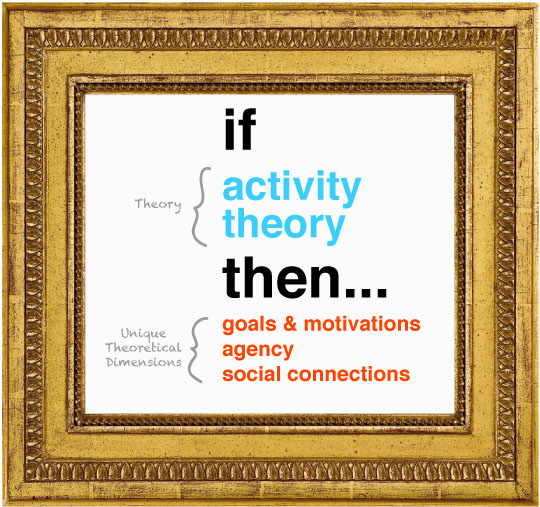
The “activity” in Activity Theory can be understood as the “purposeful, transformative, and developing interaction between actors (‘subjects’) and the world (‘objects’)” (Kaptelinin, 2013) . With this notion, the Activity Theory framework can elucidate IFTTT in three major considerations: social connections, goals & motivations, and agency.
Leontiev put forth two ideas when attempting to conceptualize activity: subjects in activities have needs, met through interacting with the world, and activities and their subjects mutually determine each other. Furthermore, human activities are organized into three layers: activity (topmost layer), actions (middle), and operations (bottom). The top layer, activity, is primarily focused on goals. The middle layer, or actions, are steps taken towards that motive. Lastly, operations are the routine processes taken on by the subject.
Goals & Motivations
Referring to Leontiev’s three layer model of human activity, we can see that IFTTT positions itself in the lowermost layer: operations. Kaptelinin explains, “...operations can be a result of step-by-step automatization of an originally conscious action” (2013). The primary feature of IFTTT is the ability to intermix web and physical tools into a recipe that helps the user towards a goal. In this sense, IFTTT aligns itself to Kaptelinin’s explanation of operations, as IFTTT reduces the need for conscious control from a user by automating system actions and responses. In his daily goal to return home from work smoothly, Joe no longer needs to remember to turn on his garage light; his recipe has turned this action into an operation. While this scenario is rather simplistic, we can easily expand on more complex examples made possible by IFTTT and “smart” technologies like the Philips Hue light bulb or Belkin power controllers. What if one were able to control all electricity in a house through a series of IFTTT recipes? Applying Leontiev’s work further, increased usage of IFTTT would serve to shape our user Joe as much as Joe shaped IFTTT through the process of recipe creation. Joe’s understanding of IFTTT would be richer as would his mastery of creating insightful and useful recipes. Taking a step back, we’d find it intriguing to consider how user goals could possibly evolve, if all such behaviors previously categorized as actions were to shift towards an (automated) operation. We imagine that goals would become more abstract and adopt a “bigger picture” nature.
Engestrom expanded on Leontiev’s work by adding an additional entity, community. All three entities subject, object, and community are mediated by additional entities: the subject/object interaction is mediated by tools, the subject/community interaction is mediated by rules, and the object/community interaction is mediated by division of labor. The outcome (or transformation of the object) of this activity system is then used by activity systems, as a continuous activity stream.
Agency
Kaptelinin & Nardi define human agency as "the ability and the need to act. The most basic meaning of the 'ability to act' is the ability to produce an effect" (Kaptelinin & Nardi, 2012). Artifacts and tools are created and designed to assist with this goal to produce an effect. While more than 83 channels exist as accessible systems to IFTTT, we can assume then that as IFTTT becomes increasingly popular, the subset of channels available will grow to accommodate new needs and requirements to produce desired effects. As much as artifacts are shaped by humans, humans are also shaped by artifacts.
Social Connections
IFTTT allows users to create recipes that can be shared and broadcasted through an online community. From a sociocultural perspective, IFTTT mediates interactions between people through use of social-interaction channels. Joe’s recipe to text his wife when he leaves works creates an additional social construct not previously available.
As Kaptelinin and Nardi state, applying one activity system model is not sufficient: real life scenarios must be represented as a network of activity systems (Kaptelinin & Nardi, 2012). Referring back to our IFTTT user Joe, several recipes intermix to create a scenario where he can efficiently head home.
Joe’s partner receives a text message when his phone detects he is leaving work. With that same detection mechanism, Joe and his team is emailed an agenda for the next day and his garage light is turned on so that he arrives to a lit up house. These recipes intermix to create an activity stream oriented towards an ultimate goal of a smooth transition from work to home.
As a mediating tool, IFTTT can indeed bring value in helping users meet their goals. With an Activity Theory lens, we can better understand the interactions between IFTTT, recipe creators like Joe, and the goals they seek to achieve, whether it be a smooth transition from work to home or some human goals not yet explored. Activity Theory can shed light on the potential for growth and improvements to IFTTT by helping inform the next design iteration of IFTTT towards an activity-centric tool. Activity Theory provides a formal framework where use cases and activities can be evaluated using an activity stream framework, or even a network of activity streams, to answer whether IFTTT is supporting meaningful human interaction and driving users towards their ultimate goals, rather than simply automating operations.

References
Kaptelinin, Victor, & Nardi, Bonnie (2012). Activity theory in HCI: Fundamentals and reflections. San Rafael, CA: Morgan & Claypool.
Kaptelinin, Victor (2013). Activity Theory. In: Soegaard, Mads and Dam, Rikke Friis (eds.), The Encyclopedia of Human-Computer Interaction, 2nd Ed.. Aarhus, Denmark: The Interaction Design Foundation.
Rogers, Y. (2012). HCI theory: classical, modern, and contemporary. Synthesis Lectures on Human-Centered Informatics, 5(2), 1-129.
IfThisThenTheory.com | An HCDE 501 Site
