IF THIS THEN THEORY
Our Website of Analysis
On this website we will analyze the website/platform “if this then that” or IFTTT using three separate human-computer interaction (HCI) theories. IFTTT combines different technology products (hardware, software, and websites) in order to create and share unique interactions. On IFTTT, there is a vast array of technology products you can combine. These products are represented as channels.
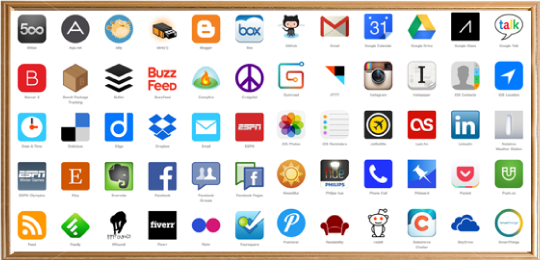
Examples of channels. Image courtesy of IFTTT.com
Channels are (often) well-known technology products that have built-in code called "triggers." On IFTTT, triggers can be "fired" through simple conditional logic—if I get tagged in a Facebook photo (trigger), then automatically save it to my iOS Photos (action). The conditional formula of having a trigger set off an action is called a "recipe." Recipe creation is very simple on IFTTT, and sharing recipes in the IFTTT community is highly encouraged.

Breakdown of the parts of a recipe. Image courtesy of IFTTT.com
An IFTTT Use Case
Due to the almost infinite amount of recipes you can create on IFTTT, we decided to narrow down our theory analysis to one unique IFTTT use case. To analyze IFTTT as a whole would prove troublesome given how its interactions vary so widely depending on the channels, triggers, actions, etc.
For our use case, we will be telling the story Joe. Joe set up an IFTTT account to automate his end-of-work process. He created three recipes on IFTTT. All three have a trigger based on his location (automatically captured via his iPhone). When he leaves his work location the triggers are fired and create three separate actions.
Recipe One: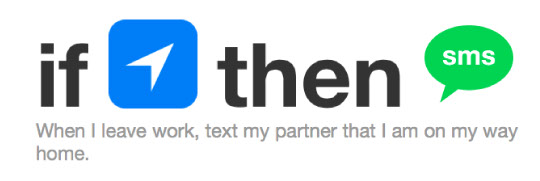
Recipe Two:
Recipe Three: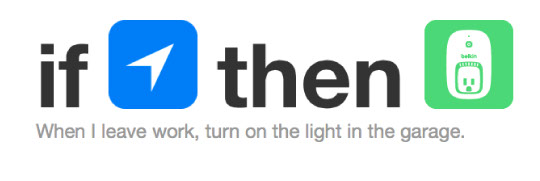
Applying HCI Theories to IFTTT
We were motivated to apply different HCI theories to IFTTT because it is such a new and innovative platform. Automation through technology used to be a specialized domain, possible only for the most technically advanced users. IFTTT changes that paradigm completely. Now users can craft unique interactions using a simple interface. The act and language of making new interactions in IFTTT is also natural—the site uses intuitive and simple terms like recipes, triggers, and actions.
IFTTT represents a interesting democratic shift in technology; it allows users to bend technology toward their goals in new and exciting ways. In many ways, IFTTT is limited only by the creativity of its users (and their ability to create unique recipes, etc.). This is in direct contrast to the technology constraints a user typically runs into when using one given system. IFTTT is a meta-system that makes other systems and products do things that used to be time-consuming and/or impossible. In short, IFTTT is ripe for research.
While IFTTT is exciting for consumers, it's especially exciting for researchers. The new interactions created by IFTTT call forth all sorts of interesting research questions; as an example, what does IFTTT mean in cultural/social/cognitive terms? Because IFTTT is so new and unique, it demands a thorough analysis. This site seeks to provide that in-depth analysis by contrasting different theoretical analyses of IFTTT. We were influenced by Rogers who said, "the widening of theory in HCI has provided many ways of conceptualizing phenomena, in terms of framing, explaining, prescribing and informing" (2012). In the pages that follow, we seek to explain IFTTT by framing it through distributed cognition, activity theory, and embodied interaction. In using a multi-theory analysis we hope to explain and make sense of IFTTT in a way not possible by a single theory alone. That said, please explore the site and discover how different theoretical framings can provide unique insights into IFTTT as a system.
Thank you for visiting,
Team IFTTT

References
Rogers, Y. (2012). HCI theory: classical, modern, and contemporary. Synthesis Lectures on Human-Centered Informatics, 5(2), 1-129.
IfThisThenTheory.com | An HCDE 501 Site
